Tiger's Nest Monastery
- Time needed
- 5–6 hours return on foot
- Altitude
- 3,120 m
- Difficulty
- Moderate
- Best time
- October–November and March–May, starting early in the day
Highlights
- Temple on a cliff at 3,120 m
- Said to be Guru Rinpoche's meditation cave
- 6.4 km return hike through pine forest
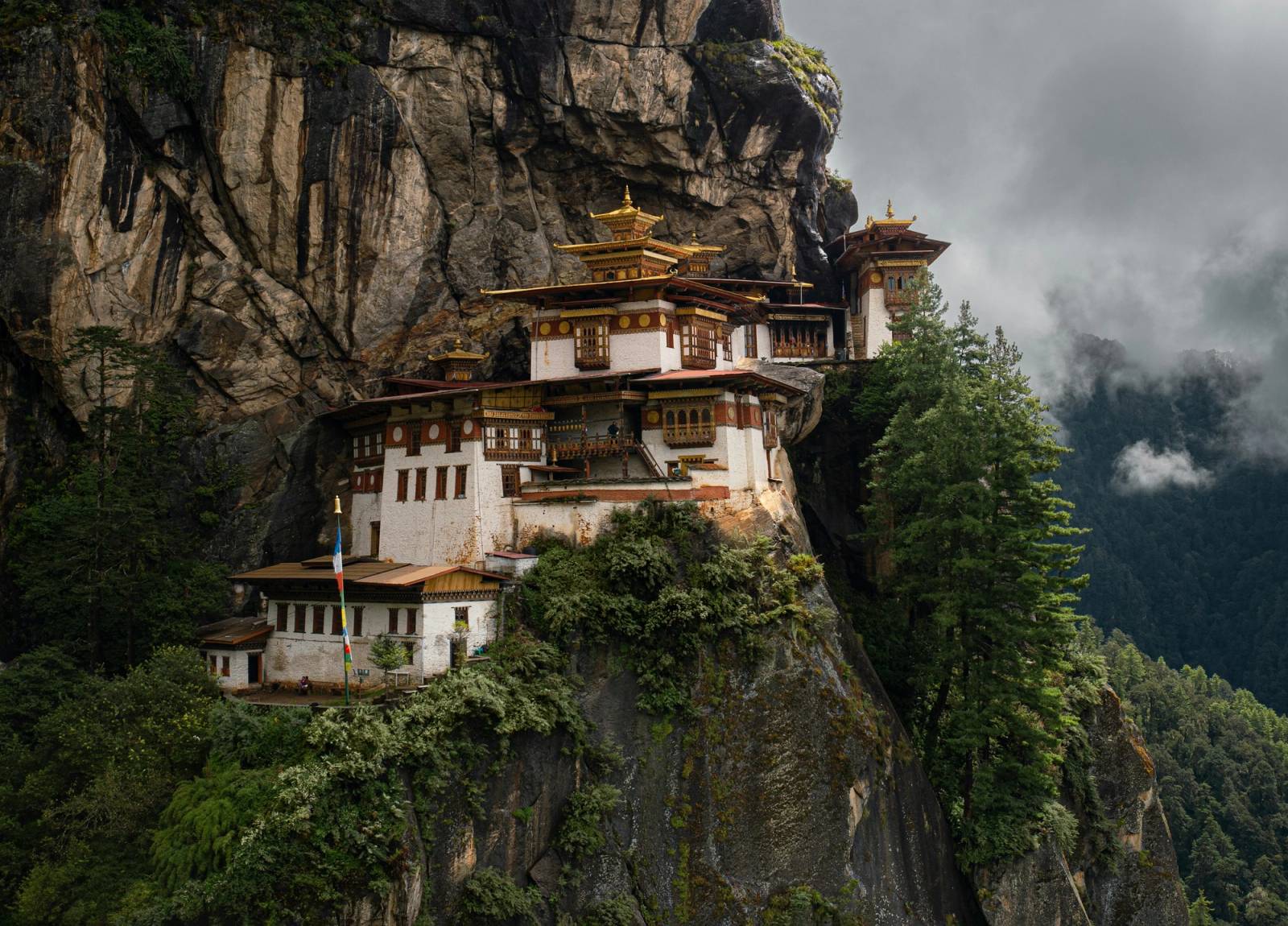
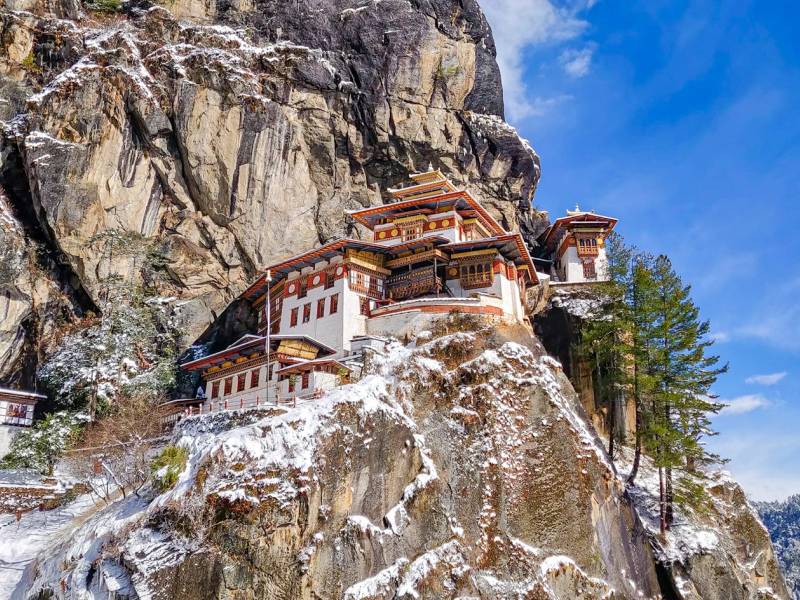
Taktsang Pelphug (also written Palphug), the Tiger’s Nest, is the building most people picture when they think of Bhutan: whitewashed walls and gold roofs fixed to a grey cliff on the western side of the upper Paro valley, about 900 metres above the rice fields. It sits at 3,120 metres, roughly 10 kilometres north of Paro town, and the only way in is on foot. For Bhutanese it is first of all a place of pilgrimage, one of the holiest sites linked to Guru Rinpoche, and you will share the path with families carrying offerings.
The cave, the tigress and the temple of 1692
The story begins in the 8th century. In the account kept by the Paro Dzongkhag administration (opens in a new tab), Guru Rinpoche came to the cave here in his wrathful form, Dorji Droloe, riding a tigress. The tigress was his disciple Tashi Kheudron, transformed for the purpose (some tellings name Yeshe Tsogyal instead), and together they subdued the local spirits and bound them as protectors of the dharma. That is where the name comes from: taktsang means the tiger’s lair, and pelphug is the cave itself.
Other meditators followed. The poet-saint Milarepa (1040–1123) is said to have spent three years here, and the lama Phajo Drugom Zhigpo arrived in 1219 and stayed six. Zhabdrung Ngawang Namgyal came in 1646 and decided a proper temple should stand at the cave. He passed the task to his spiritual heir, Gyalsey Tenzin Rabgye, and work started in 1692. The builders could not make the foundation stones stay on the sloping ledge, so, the story goes, Tenzin Rabgye cut his own hair and mixed it into the mortar. The temple was finished in 1694.
In April 1998 a fire destroyed much of the main building and a large part of its paintings and statues. It was rebuilt to the old plan, and the restoration was completed in 2005.
What to look for inside
The Paro Dzongkhag lists nine temples in the complex, among them the Guru Druphu (the meditation cave), the Guru Tshengyed Lhakhang for Guru Rinpoche’s eight manifestations, and the Tshepamed Lhakhang for Amitayus, the Buddha of long life. Your guide will take you through the ones open that day. Things worth asking about:
- The main statue of Guru Rinpoche. It was cast in bronze by a Nepali craftsman called Pentsa. When porters could not get it down the last narrow stretch of path, the local protector Singye Samdrup is said to have taken human form and carried it in on his back.
- The ritual dagger in the Pelphug Lhakhang. Tradition holds that a phurba flew into the cave while Guru Rinpoche’s disciples were in retreat, and that it is still kept there.
- The Choeten Lhakhang, built around a stupa linked to Langchen Pelgye Singye, one of Guru Rinpoche’s close disciples, who also meditated here. People make wishes near it on auspicious days.
The walk up, stage by stage
The trail starts from a car park at about 2,600 metres, a drive of about 20–30 minutes from Paro town. It is roughly 6.4 kilometres there and back with about 520 metres of climbing, on a wide dirt path that is steady rather than steep.
- Car park to the cafeteria. The first half climbs through pine forest hung with prayer flags and takes most people 1–2 hours. Ponies can be hired for this section only. They carry you up, not down.
- Cafeteria to the viewpoint. The cafeteria sits at around 2,900 metres, with tea, a simple lunch and your first clear look across the gorge. Above it the path keeps climbing to a ledge level with the monastery, the place for the classic photograph.
- Down and up to the gate. From the viewpoint, stone steps drop to a bridge beside a waterfall, then climb again to the entrance. It is short but it is the steepest part of the day, and you do it twice.
Most walkers take 2.5–3.5 hours up, 1.5–2 hours down, and spend about an hour inside.
Visiting: dress, bags and cameras
- Dress as for any temple. Cover yourself from shoulders to knees: long sleeves and long trousers or a long skirt. Hats come off at the gate and shoes at each temple door. Our cultural etiquette guide has the detail.
- Bags, phones and cameras stay at the gate. They are left with the staff at the entrance and there is no photography inside. Take your pictures from the viewpoint.
- Go with your guide. A licensed guide is needed to enter monuments and dzongs in Bhutan, as the official Bhutan travel FAQs (opens in a new tab) explain.
How hard it is, and how to make it easier
Anyone who walks regularly can do it. It is the altitude, not the gradient, that slows people down, so go at a pace where you can still talk.
- Keep it for late in your trip, after a few days in Paro, Thimphu or Punakha to adjust to the height.
- Start early. You climb in the shade and reach the gate before the late-morning groups.
- Wear shoes with real grip. The dusty descent is where people slip, and a walking pole helps the knees.
- Carry water, a snack, sun cream and a warm layer for the top. Our packing checklist covers the rest.
- Children of about seven and up usually manage it well.
- If you have heart or breathing problems, talk to your doctor first and read our safety and health guide.
When to go
October and November give the clearest, most settled days, and March to May is a close second, with rhododendrons flowering in the forest. From June to September the monsoon brings cloud and a muddy path. Winter mornings are cold but often clear, and the trail is quieter. The best time to visit Bhutan guide compares the seasons in full.
Fitting it into your days in Paro
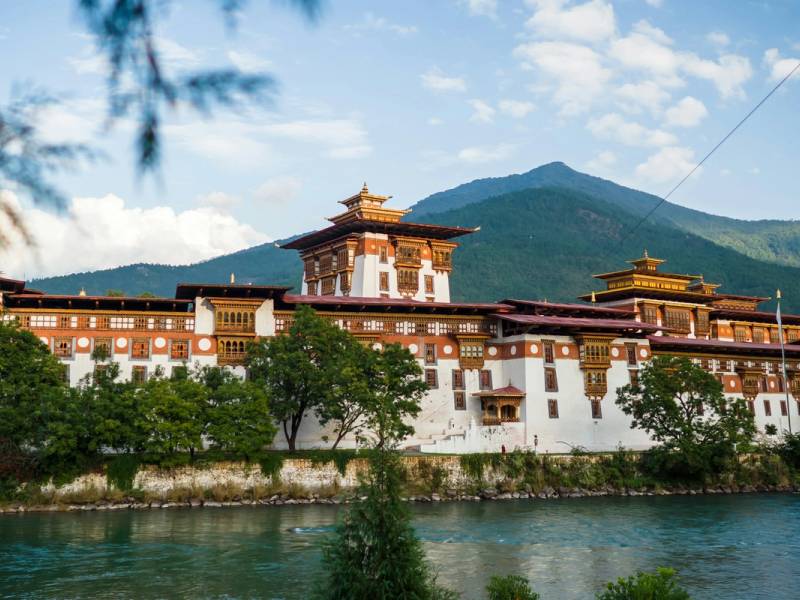
The hike fills most of a day, so pair it with something gentle. Kyichu Lhakhang, one of the oldest temples in the country, sits beside the road back to town, and Paro Dzong is at its best in late-afternoon light. Many travellers keep Tiger’s Nest for their last full day before flying out of Paro, when they are best acclimatised. The Paro destination page covers the other sights in the valley.
Last reviewed 24 September 2026
More to see in Paro
Paro Dzong (Rinpung Dzong)
Rinpung Dzong, consecrated in 1646, is Paro's fortress-monastery: home to the district monk body and government offices, and the setting for the Paro Tshechu each spring. You reach it on foot across a covered wooden bridge over the Paro Chhu.
Chele La Pass
Chele La is the road pass between Paro and the Haa Valley, usually given as 3,988 metres. On a clear morning you can see Jomolhari from the prayer flags at the top. Most people stop here on the drive into Haa, or walk down to Kila Goemba nunnery.
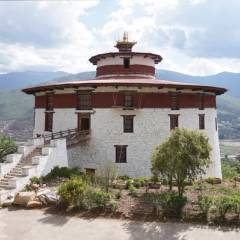
National Museum of Bhutan
Bhutan's first museum has been housed since 1968 in Ta Dzong, the round watchtower built in 1649 above Paro Dzong. Restored after the 2011 earthquake and reopened in 2020, it holds thangkas, masks, bronzes, old weapons, postage stamps and natural history displays.
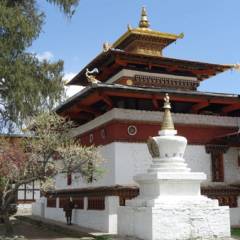
Kyichu Lhakhang
One of Bhutan's oldest temples, traditionally dated to 659 and credited to the Tibetan king Songtsen Gampo as one of 108 temples built to pin down a demoness. Its Jowo Shakyamuni statue is revered as highly as the Jowo in Lhasa. It is a few minutes' drive north of Paro town.
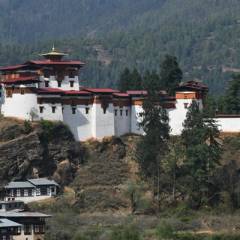
Drukgyel Dzong
Built in 1649 at the head of the Paro valley to mark victory over Tibetan invaders, the fortress of the victorious Drukpas burned in 1951 and stood as a ruin for decades. Rebuilt with traditional methods on the King's command from 2016, the work was completed in December 2022.
Planning a trip that includes Tiger's Nest Monastery?
Tell us when you would like to travel. We reply within 24 hours with a free day-by-day plan and a price.

Karma ChodenOperations manager, Bhutan Tour Itinerary
Or call +975 17 81 70 52info@bhutantouritinerary.com
Mon–Sat, 9am–6pm Bhutan time (GMT+6)