Bhutan cultural etiquette
What to wear, when the camera goes away, and how to behave in a temple, a dzong or someone's home.
On this page
- What to wear to a dzong or temple
- Greetings, gifts and a meal in someone’s home
- Inside a temple, and which way you walk
- Can you take photos in Bhutanese temples?
- Why phalluses are painted on Bhutanese houses
- Mountains you can walk to but never climb
- Smoking, vaping and the end of Dry Tuesday
- How much to tip your guide and driver
- Ask us the awkward questions
Most first-time visitors worry about getting something wrong inside a temple. In practice Bhutan’s cultural etiquette is a short list: what you wear, when your shoes and hat come off, where the camera stays, and which way you walk around a chorten.
What to wear to a dzong or temple
Bhutan’s Department of Tourism (opens in a new tab) sets the dress code, and our guide vouches for you at the door, so we hold every group to it.
- Long sleeves in a temple, legs and shoulders covered, no shorts.
- Shoes off on entering, so slip-ons beat boots with long laces.
- Caps and hats off at sacred sites, and in front of an elder.
- Silence inside.
The rules do not relax because you worked for the view. Paro Taktsang sits at 3,120 m (10,240 ft), four to six hours’ round trip from a trail starting near 2,100 m, and you still cover up and take your shoes off at the top. Our packing guide covers the layers.
Do you have to wear the gho or kira?
No. Bhutanese dress follows Driglam Namzha, the code of etiquette introduced by Zhabdrung Ngawang Namgyal in the 17th century. Since 1989, under the Fourth King Jigme Singye Wangchuck, the gho (a man’s knee-length robe belted with a cloth kera) and the kira (a woman’s ankle-length wrapped dress) have been compulsory in schools, government offices and dzongs. The obligation is on citizens, not on you.
Leave the kabney alone too, the silk sash Bhutanese men wear left shoulder to right hip into a dzong; women wear the rachu over the kira. Its colour is fixed by rank, which is why a dzong courtyard reads like a rank chart.
| Kabney colour | Worn by |
|---|---|
| Saffron | The King and the Je Khenpo |
| Orange | Lyonpos (ministers) |
| Red | Dashos |
| Green | Judges |
| Blue | Members of parliament |
| White with red stripes | Gups (village headmen) |
| Plain white | Ordinary citizens |
Greetings, gifts and a meal in someone’s home
“Kuzu zangpo la” is hello, “Kadrin chey la” is thank you, and the “la” on the end is a politeness marker for elders and strangers that Bhutanese attach to English sentences too.
Shoes come off at the door of a home, as at a temple. Sit cross-legged on the floor with a monk, a nun or your host, and keep your feet from pointing at anyone or at an altar.
A small supply of doma, areca nut with betel leaf and slaked lime, is both the standard gift and the standard social offering, exchanged on meeting and after meals.
At the table, refusal is a ritual rather than an answer. Decline the first offer with “Meshu meshu”, lightly covering your mouth, then accept when your host insists. “Tse mayang” means you have had enough. Eat with your right hand; serve and receive with both.
Inside a temple, and which way you walk
A small cash offering on the altar or in front of a statue is how you thank the monks; you do not hand them a tip.
Chortens, mani walls and prayer wheels are passed clockwise, with the structure on your right, and the wheels turned clockwise. Thimphu’s Memorial Chorten has 108 large prayer wheels on two concentric terraces, each engraved with Om mani padme hum.
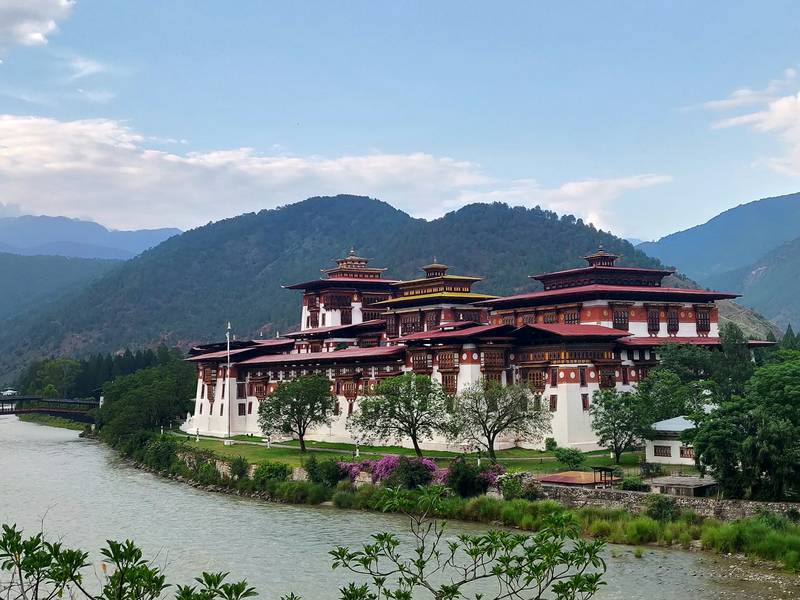
Working buildings keep working hours. Tashichho Dzong in Thimphu is the seat of government and opens to visitors only after the offices close, around 5:30–6:30 pm on weekdays at the time of writing.
A Department of Tourism-certified guide is still required for dzongs, monasteries and monuments, and beyond the Paro–Thimphu–Punakha corridor, capped at 22 visitors per guide. Your guide tells you when the camera goes away.
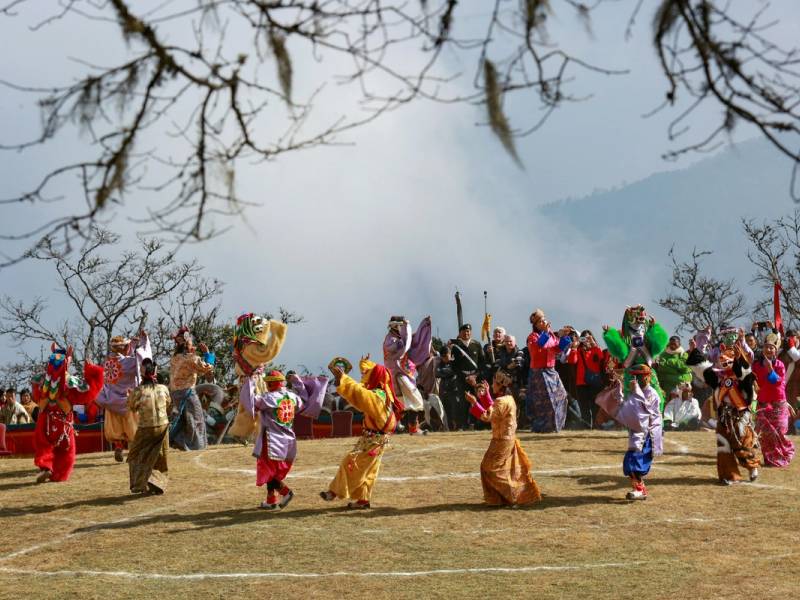
Tshechu dates follow the Bhutanese lunar calendar and move every year: Thimphu Tshechu fell on 21–23 September in 2026 and 2027 will be different. We check the calendar for your travel year before quoting a festival tour.
Can you take photos in Bhutanese temples?
Exteriors, courtyards, landscapes and street scenes are fine. Temple interiors, inner sanctums and goembas are almost always off-limits. The “no photography in Bhutan” line you read online is wrong; so is assuming you can shoot inside.
At Paro Taktsang, cameras, phones and all electronics go to the sentry before you enter, so plan your Tiger’s Nest shots for the approach. Ask people first, every time, monks and festival dancers included.
Drones are effectively banned for visitors: a flight needs approval from the Bhutan Civil Aviation Authority, which goes to government bodies and the occasional licensed film crew. A drone in your luggage is declared at Paro customs and returned when you leave.
Why phalluses are painted on Bhutanese houses
They trace to Lama Drukpa Kunley (1455–1529), the Divine Madman, who is said to have subdued demons with what tradition calls his Flaming Thunderbolt of Wisdom. The paintings are protective, warding off evil spirits, the evil eye and malicious gossip, and carrying a fertility association. They are not erotic art, and mugging for a photo in front of your hosts reads as crass.
Most of our cultural tours stop at Chimi Lhakhang, the fertility temple built in 1499 about 10 km from Punakha, a 20-minute walk through rice fields from Sopsokha. The resident monk blesses pilgrims by touching their head with a 25 cm (10 inch) phallus of wood, bone and ivory.
Mountains you can walk to but never climb
Religion and the monarchy are not debating topics here, and the same respect sits behind a rule travellers find strange. Peaks above 6,000 m were closed to climbing in 1994 and all mountaineering was prohibited from 2003, because summits are held to be the homes of territorial deities.
Gangkhar Puensum (7,570 m / 24,836 ft) is the highest unclimbed mountain on earth. You can walk long and high on our treks; you just cannot stand on a summit.
Smoking, vaping and the end of Dry Tuesday
Bhutan is not the country where tobacco is illegal, whatever older articles say. Parliament legalised import, sale and purchase through authorised micro-retailers when it amended the Tobacco Control Act in July 2021. Growing and manufacturing tobacco here is still banned.
Smoking in public is still an offence, at Nu 500 a time; the Bhutan Food and Drug Authority reissued that notification on 17 June 2026. The 2010 Act covers most indoor and outdoor public places and public transport, hotel lobbies and festivals included. Vaping sits in a legal grey area that was under review as of early 2026, with e-cigarette imports up from 994 units in 2022 to 448,086 in 2025, so treat a vape as you would a cigarette.
“Dry Tuesday” is over. The nationwide ban on Tuesday alcohol sales, in force since 1999, was scrapped by the Ministry of Industry, Commerce and Employment, and licensed hotels, restaurants and shops now sell on Tuesdays. Dry days around major religious festivals still apply, the drinking age is 18, drinking in public is prohibited, and sales generally stop at 10 pm.
Ara, distilled from fermented rice, maize, wheat or millet, is what hospitality looks like in a farmhouse. A flat refusal reads as rude; a token sip is the polite middle, and our food and drink guide has more.
How much to tip your guide and driver
Tipping is never compulsory and is not part of the Sustainable Development Fee. At the time of writing, customary rates run about USD 10–15 a day for your guide and USD 5–8 a day for your driver if you travel alone, less per head in a group, in an envelope on the last day.
The SDF itself is USD 100 per person per night, or INR 1,200 for Indian nationals, under a 50% concession running to 31 August 2027, plus a USD 40 visa fee. Our visa and SDF guide has the rest; our tours show what sits inside the price.
Ask us the awkward questions
Nobody expects you to memorise this. Your guide tells you when to cover up and when to leave the camera in the vehicle, without making a thing of it.
If you would rather settle something first, a temple you want to photograph, a homestay you have been invited to, whether your dates land on a festival dry day, write to us and we will check it. Altitude and medical questions sit in our safety and health guide.