Bhutan festival calendar
Bhutan's tshechu dates move every year with the lunar calendar. Here are the tentative 2027 dates, and what actually happens across the days of a festival.
On this page
Paro Tshechu falls 18–22 March in 2027 and Thimphu Tshechu 10–12 October, both a different week from 2026. Here is how tshechu dates get set, what happens over the days of one, and which are worth a trip. The 2027 calendar below is tentative, as of September 2026.
Why Bhutan’s festival dates move every year
Tshechu is Dzongkha for “tenth day”: the 10th day of a lunar month, the day associated with Guru Rinpoche (Padmasambhava). Each district keeps its own lunar month, so no two valleys hold theirs in the same week.
Paro ran 29 March to 2 April in 2026 and moves to 18–22 March in 2027; Thimphu was 21–23 September in 2026 and is 10–12 October in 2027. A page calling Thimphu Tshechu an October festival is quoting one year as a rule.
The Department of Tourism (opens in a new tab) publishes the schedule a year or more ahead, marked tentative, and the 2027 list was last updated in February 2025. Dzongkhag and monastic authorities confirm the days closer to the event, so a date can still move. We watch the confirmations for your valley.
What happens at a tshechu
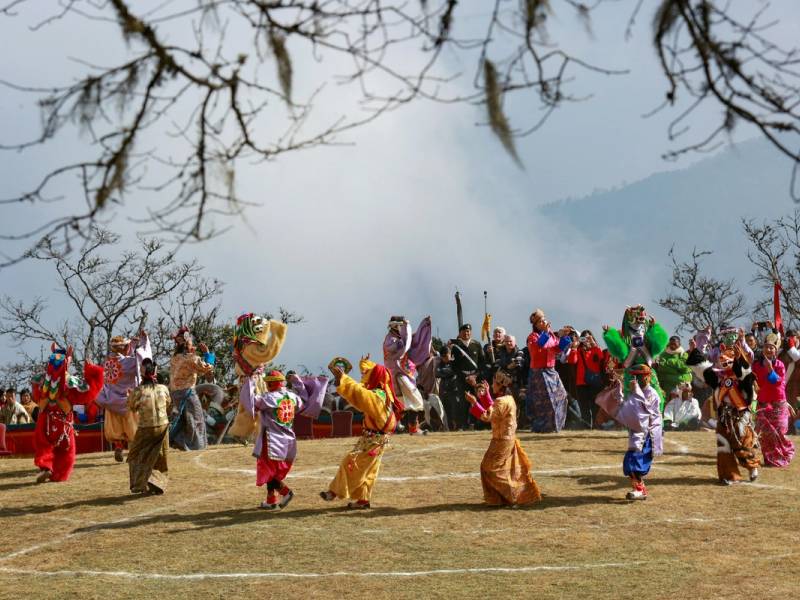
A tshechu is a religious event the whole district attends, in a dzong courtyard or on a temple ground over two to five days. Monks and lay dancers perform cham in brocade and carved masks; families come in their best, spread a blanket and stay all day.
The same dances recur: the Black Hat Dance (shanag), the Dance of the Four Stags, the Dance of the Terrifying Deities. Guru Tshengye, the eight manifestations of Guru Rinpoche, is danced by eight dancers.
Working between them are the atsaras, clowns in red hawk-nosed masks carrying wooden phalluses. The name is the Sanskrit acharya, teacher: they narrate the dances, run the ceremony and keep people off the dance ground.
You do not need every day, and our guides know which dances fall when at each dzong.
The thongdrel, and why you get up before dawn
A thongdrel is a giant appliqué thangka, the large ones roughly 30 m by 45 m (98 ft by 148 ft), usually showing Padmasambhava. It is unfurled at dawn on the final day and rolled away before direct sunlight reaches it, so the window can be two hours.
Thong is sight, drel is liberation: seeing it is believed to confer merit and help liberate the viewer from samsara, which is why the courtyard fills in the dark. Paro’s is the Guru Tshengye Thongdrel.
Be in the valley the night before a thongdrel morning, not on a flight that day.
The festival year, season by season
Spring: February to May
Punakha Drubchen comes in mid-February, three days re-enacting the 1639 invasion of the valley by a Tibetan-Mongol force, with local men as pazaps, militia in red and black with swords, fighting in and around the dzong. Punakha Tshechu starts straight afterwards at the same dzong, so three or four nights in Punakha covers both.
Paro Tshechu is the one most visitors come for: five days at Rinpung Dzong in Paro, closing with the pre-dawn Guru Tshengye Thongdrel. Ura Yakchoe closes the spring at Ura Lhakhang in Bumthang, built around a relic shown once a year and kept by one family’s descendants.
Summer: June to August
Nimalung and Kurjey Tshechus in Bumthang both mark Guru Rinpoche’s birth anniversary, Nimalung starting two days before Kurjey, so one June trip gets you both. Nimalung unfurls a Guru Thongdrel of its own. Kurjey Lhakhang is named for what is inside it: kur is body, jey is imprint, and the imprint sits in a cave in the oldest of its three temples.
Confirm the Haa Summer Festival before booking around it: it ran mid-July historically, but the 2026 Department of Tourism schedule showed a Haa Spring Festival in April and a Haa Tshechu in September instead. Those three are the summer list; more in Best Time to Visit Bhutan.
Autumn: September to November
Thimphu Tshechu fills the courtyard of Tashichho Dzong for three days, preceded by the Thimphu Drubchen. Wangdue Tshechu is back in its dzong, which burned down in June 2012 and was reconsecrated on 11 November 2022. Wangdue, Thimphu and Gangtey all fall inside one October week in 2027, Gangtey above Phobjikha.
Jambay Lhakhang Drup runs four days at the 7th-century temple in Bumthang. At the mewang, gomchens perform purification rites while the crowd leaps through a burning gateway; three jumps is believed to keep misfortune off you for the year. At midnight comes the tercham, sixteen dancers wearing nothing but face coverings. Photography and filming are forbidden during it.
The Black-necked Crane Festival is one day, every 11 November at Gangtey Gonpa, fixed because it is the Fourth Druk Gyalpo’s birth anniversary. Phobjikha is Bhutan’s largest wintering habitat for the birds, roughly 300 a year. The Jomolhari Mountain Festival, above 4,000 m at Soe Yaksa, is built around snow leopard conservation and reached only on a multi-day trek.
Winter: December to February
Mongar and Trashigang fall a day or two apart, so one eastern loop takes in both. Paro draws the visitors; these two do not.
Druk Wangyel Tshechu is on 13 December every year at Dochula pass, danced by the Royal Bhutan Army rather than by monks or laymen. Established in 2011, it marks the Fourth Druk Gyalpo and the 2003 operation against insurgent camps in the south, and the pass carries 108 chortens for the soldiers killed.
Trongsa and Lhuentse run together, though in the 2027 cycle both land on 5–9 January 2028. Dangpa Losar, the new year most people mean, is 7–8 February 2027.
Tentative tshechu dates for 2027
| Festival and place | 2027 dates |
|---|---|
| Lhamoi Dromchhen, Trongsa | 11–13 Feb |
| Punakha Dromchoe | 13–15 Feb |
| Punakha Tshechu | 16–18 Feb |
| Paro Tshechu | 18–22 Mar |
| Ura Yakchoe | 18–22 Apr |
| Nimalung Tshechu | 12–14 Jun |
| Kurjey Tshechu | 14 Jun |
| Thimphu Drubchen | 5 Oct |
| Wangdue Tshechu | 8–10 Oct |
| Thimphu Tshechu | 10–12 Oct |
| Gangtey Tshechu | 13–15 Oct |
| Jomolhari Festival | 14–15 Oct |
| Black-necked Crane Festival | 11 Nov |
| Jambay Lhakhang Drup | 14–17 Nov |
| Mongar Tshechu | 6–8 Dec |
| Trashigang Tshechu | 7–9 Dec |
| Druk Wangyel Tshechu | 13 Dec |
| Trongsa and Lhuentse | 5–9 Jan 2028 |
Treat every line as tentative until local authorities confirm it. Our festival tours are built around these dates, and our cultural tours can shift to catch one if your dates are close.
How far ahead to book, and what it costs
Six months ahead is the working rule for tshechu season: Drukair (opens in a new tab) generally releases its schedule only three to six months out, and seats and hotel rooms in Paro, Thimphu and Bumthang go first.
Paro is Bhutan’s only international airport, at 2,235 m (7,333 ft), and flights run under visual meteorological conditions in daylight only, so one weather delay cascades into the next. Build a buffer day before any thongdrel morning; more in Getting to Bhutan.
The old USD 250 minimum daily package was abolished on 20 June 2022; there is no government-set minimum spend now. You pay the Sustainable Development Fee of USD 100 per person per night, confirmed at that rate until 31 August 2027, plus hotels, meals, transport, guide and entry fees. Children aged 6 to 11 pay half and under-6s are exempt.
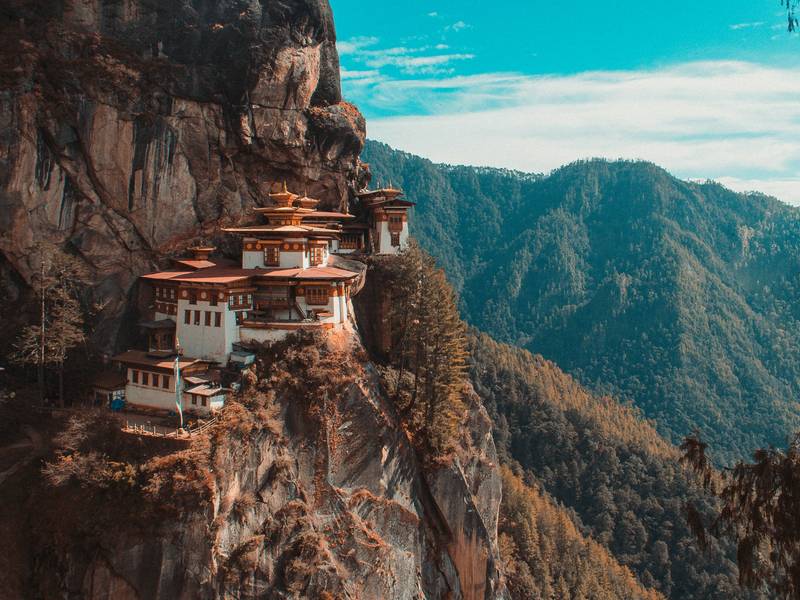
We handle your visa through the Department of Immigration (opens in a new tab) portal: USD 40 per person, non-refundable, about five working days. See Bhutan Visa and SDF. A licensed guide is still required outside the Paro–Thimphu–Punakha corridor and for dzongs and the Tiger’s Nest hike.
What to wear, and when the camera goes away
Dzongs hold visitors to the same standard as everyone else. No shorts, knees and shoulders covered, long sleeves on a collarless shirt, no flip-flops. Bhutanese come in gho and kira with the kabney or rachu, so leave the trekking gear. More in Dress Code and Etiquette.
Cameras are fine in the courtyard; inside any lhakhang or goemba they go away. No flash during the dances, never step onto the dance ground, and ask before photographing monks or dancers. Drones need a government permit. See Photography in Bhutan.
Ask us before you book the flights
Send us your dates and we will tell you which festivals fall inside them, which are confirmed, which are tentative, and where the buffer day should sit. If you are flexible by a week, we will usually find you a thongdrel.
Tell us your dates and we will come back with what is on.