Bhutan entry requirements
Passport, visa clearance, the SDF, permits and customs: what we file for you, and what you need in your hand when you land at Paro.
On this page
- What you need before you fly
- Your passport, and what visa clearance actually is
- What the Sustainable Development Fee costs
- Indian, Bangladeshi and Maldivian nationals
- Ports of entry: Paro and the four land borders
- The guide rule, and why route permits no longer exist
- Customs: alcohol, tobacco, cash, antiques and drones
- At immigration: e-gates and the entry seal
- Ask us
You need a passport valid six months past the day you leave Bhutan, visa clearance approved before you fly, and the US$100-a-night Sustainable Development Fee paid in advance. We file most of it for you; here is the rest, from customs limits to what happens at Paro immigration.
What you need before you fly
- A passport valid for at least six months from the date you intend to leave Bhutan.
- An approved visa clearance letter, printed. The application fee is US$40 per person, one-off and non-refundable.
- The Sustainable Development Fee: US$100 per adult per night, paid up front.
- A certified guide for your time in Bhutan. Booking through a tour operator is optional; the guide is not.
- Travel insurance. Strongly recommended, not required.
Indian, Bangladeshi and Maldivian nationals follow different rules, below.
Insurance stopped being a condition of visa processing on 23 April 2024. The Department of Immigration (opens in a new tab)’s own checklist page still lists it, which is why so many sites still call it compulsory. We ask every guest to carry it anyway.
Your passport, and what visa clearance actually is
The six months runs from the day you leave Bhutan, not the day you arrive.
We apply online with a scan of your passport. A correctly submitted application is reviewed within five working days, so we file two to three weeks ahead and leave room to fix anything that comes back.
What arrives is a visa clearance letter: a PDF you print and show at airline check-in, then again at Paro. In the Paro immigration office’s own wording, visa clearance alone does not guarantee the right to entry or stay. You are admitted when an officer puts the entry seal in your passport. There is no visa on arrival for non-regional passports.
A tourist visa allows 90 days from the date of entry, extendable online through the same portal login before the original expires. The step-by-step is in our visa and immigration guide.
What the Sustainable Development Fee costs
| Who | SDF per person, per night |
|---|---|
| Adult, non-regional passport | US$100 |
| Child aged 6-11 | US$50 |
| Child under 6 | No SDF |
| Indian national, adult | Nu./INR 1,200 |
| Indian national, child 6-11 | INR 600 |
US$100 is a 50% discount on the statutory US$200. The Department of Tourism (opens in a new tab)’s press release of 25 August 2023 runs that discount to 31 August 2027, so US$100 is confirmed only to that date; we quote the rate in force for your dates.
Ignore anything you read about a minimum daily package of US$200-250 per person per night. It went when the Tourism Levy Act came into force on 23 September 2022, so you now pay the SDF plus what your trip actually costs: a cultural tour and a luxury lodge trip no longer price the same. More in our guide to the SDF.
A 5% Goods and Services Tax took effect on 1 January 2026 on hotels, guides and transport, replacing the old 10% sales tax. It does not touch the SDF or the visa fee.
Indian, Bangladeshi and Maldivian nationals
Indian nationals need no visa, only an entry permit: at the Regional Immigration Office in the border town if you come by road, at Paro if you fly.
Travel on a valid Indian passport with at least six months’ validity, or an original Voter Identity Card from the Election Commission of India with passport-size photographs. Children under 18 without a passport need an original birth certificate. Aadhaar cards, PAN cards and driving licences are not accepted. Send us a photo of the document you plan to travel on and we will check it.
Bangladeshi and Maldivian nationals are visa-exempt for up to 14 days. Bhutan’s official tourism FAQ sets a concessionary SDF for those two countries: the first 15,000 guests pay US$15 or INR 1,200 per night.
Ports of entry: Paro and the four land borders
Bhutan has one international airport at Paro and four land ports: Samtse, Phuentsholing, Gelephu and Samdrup Jongkhar.
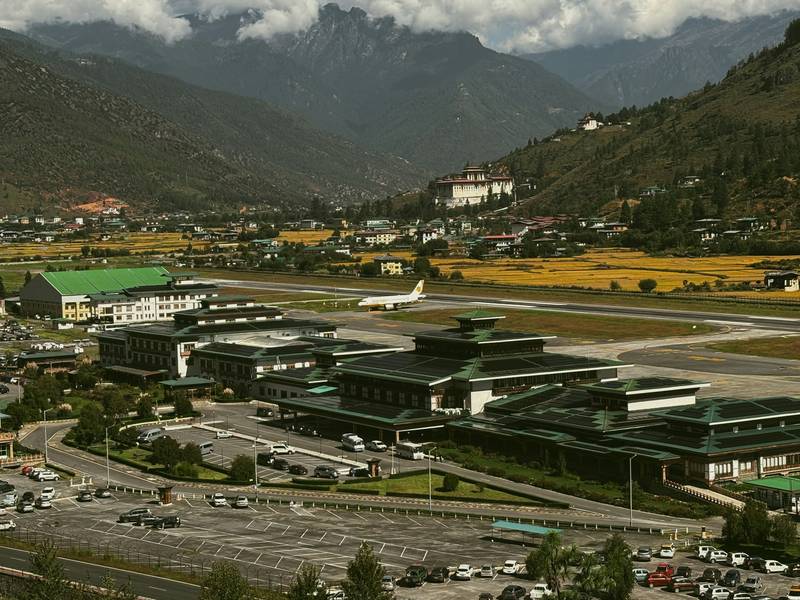
Paro sits at 2,235 m (7,333 ft) with a single 2,265 m (7,431 ft) runway among peaks of about 5,500 m. There is no radar, approaches are flown manually in daylight, and only specially certified pilots may fly there, so schedules are daytime only and weather moves them.
Gelephu is no longer only a land port. Drukair (opens in a new tab) started scheduled Gelephu-Kolkata flights in December 2025, and a much larger Gelephu International Airport is due to open in 2029 for Gelephu Mindfulness City. Routings are in getting to Bhutan.
Day visitors to those four border towns pay no SDF for up to 24 hours. The Department of Tourism published the SOP on 27 April 2024, and the FAQ at the time of writing dates the waiver from 2 June 2026. It covers the designated town zones only; past the checkpoint the normal fees and rules apply.
The guide rule, and why route permits no longer exist
Route permits for interior travel were abolished on 6 March 2023. Travelling with a Department of Tourism-certified guide, you may go anywhere in Bhutan apart from gazetted prohibited or restricted areas, with no permit to produce and no stop at interior checkpoints such as Rinchending.
Bhutan works off a negative list instead. It published lists of prohibited and restricted areas alongside that announcement, and only those need special clearance, which we arrange. Our permits and restricted areas guide covers what that means for eastern and high-Himalayan itineraries.
The guide requirement has not gone anywhere. The official FAQ states a guide is mandatory at all times, and specifically for visitors entering by land who travel beyond the border towns. A Department of Tourism announcement of 14 September 2026, “Announcement on Guide Engagement on Land Port”, tightened the rules for land arrivals. If you are driving up from Jaigaon, talk to us before you fix the date.
Customs: alcohol, tobacco, cash, antiques and drones
- Alcohol. Used personal effects and one bottle no larger than one litre come in free of duty. Goods for personal use or gifts are allowed up to Nu 10,000 in value, including spirits up to two litres and perfume up to 100 ml.
- Tobacco. Up to 200 cigarettes, or three 50-gram tins of pipe tobacco, for personal use, at 100% customs duty. Tobacco is not banned: import, sale and purchase were legalised in July 2021, with Bhutan Duty Free Limited the sole authorised importer. Smoking in public places is still prohibited.
- Currency. Anything above US$10,000 or the equivalent must be declared on entry and on exit, and a false declaration attracts fines. Indian travellers may carry up to Rs 25,000 in denominations of Rs 500 and below, and above that only notes of Rs 100 or lower. The Ngultrum is pegged 1:1 to the rupee, as our money guide explains.
- Antiques. Export is prohibited; Bhutanese law lists the artistic, historic, religious and archaeological objects that may not leave. A new thangka or other non-antique religious piece needs an export clearance permit, straightforward from a shop your guide knows.
- Drones. Flying one needs Bhutan Civil Aviation Authority approval, which in practice goes only to government organisations. Declare a drone at Paro customs and it is held and returned on departure. Undeclared drones are confiscated.
At immigration: e-gates and the entry seal
Paro switched on an Automated Immigration Clearance System on 20 February 2026: 12 e-gates, six arrivals and six departures, built for about Nu 60 million, cutting clearance from three to five minutes to roughly one. The Department of Immigration has published e-gate videos for foreign travellers as well as Bhutanese citizens, so visitors can use the gates too.
Keep your passport and the printed clearance letter in hand. The entry seal is the moment you are legally admitted; our guide meets you in arrivals once you are through.
The Ministry of Home Affairs proposed a Bhutan Digital Arrival Card and an electronic travel authorization on 22 April 2026, with no start date released. We will file it if it arrives before your trip.
Ask us
Rules here change by announcement rather than by legislation, sometimes with a few weeks’ notice, and we read every one because we file the applications.
Send us your passport details and your dates through the contact form and we will tell you what applies to your nationality, your route and your travel month. If you are still choosing, start with our tours or with festival tours, where dates are announced each year rather than falling on the same date.