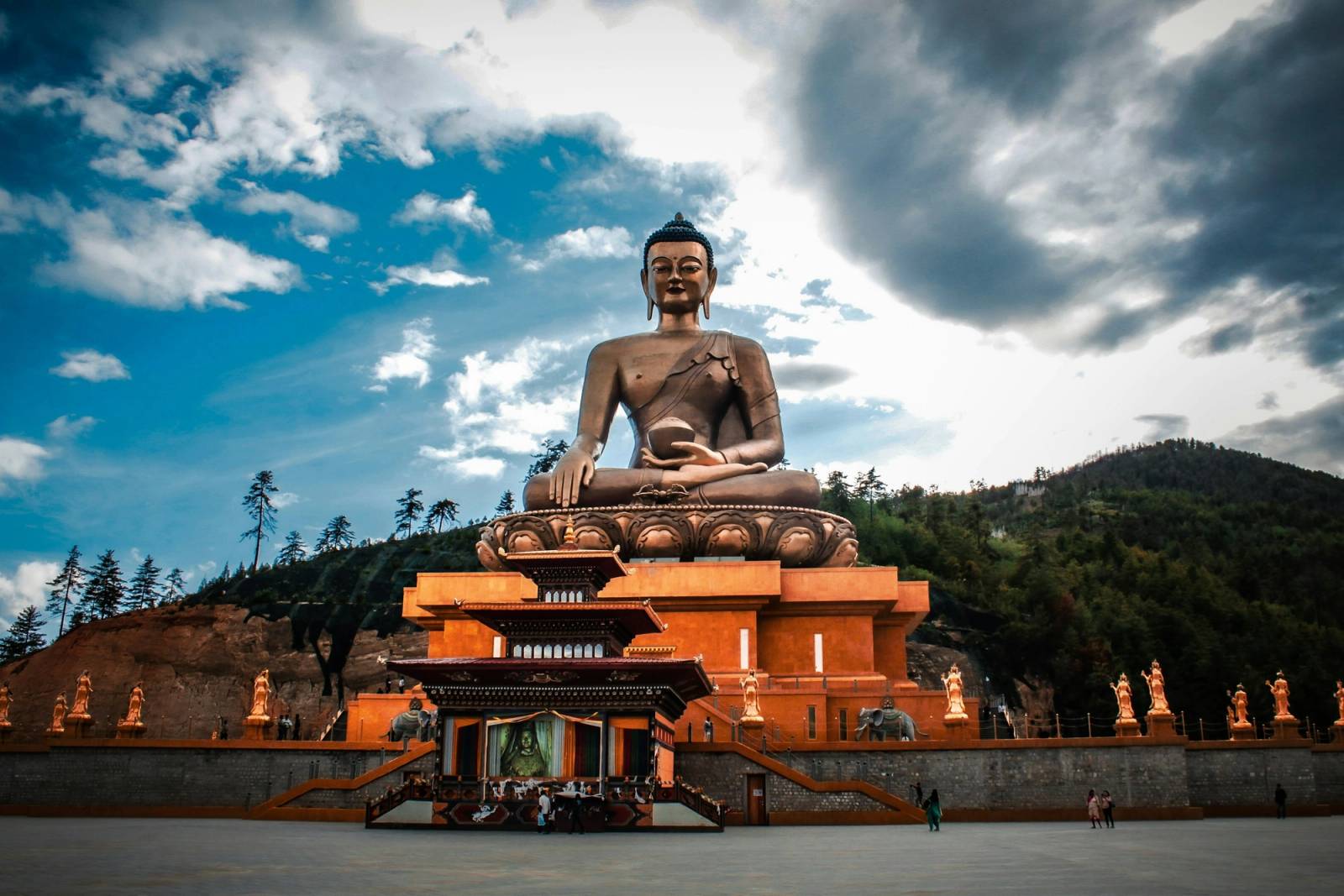
Buddha Dordenma
- Time needed
- About 1 hour; 2–3 hours with the forest walk
- Best time
- Early morning or late afternoon, when it is quieter
Highlights
- Gilded bronze statue over 50 m tall
- 125,000 small gilded statues inside
- Wide views over the valley and city
A giant Buddha over the southern end of the valley
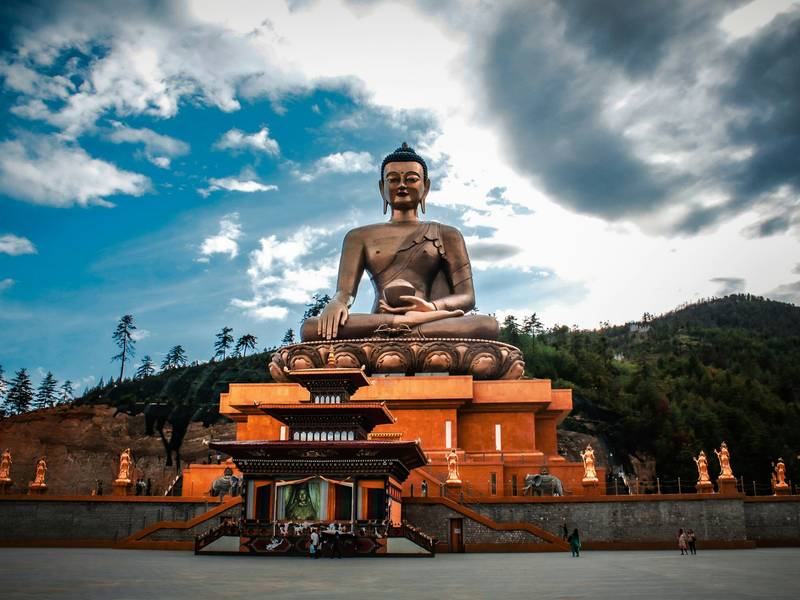
Buddha Dordenma is a huge seated statue of Shakyamuni, the historical Buddha, on the hill of Kuensel Phodrang above the southern approach to Thimphu. It is cast in bronze and gilded, and it sits on a large building that serves as its throne and holds a shrine hall. Many people simply call the place Buddha Point.
Its height is usually given as 51.5 metres (169 feet); the Thimphu dzongkhag administration (opens in a new tab) gives 54 metres. Either way it is one of the largest seated Buddha statues in the world, though not the largest, whatever you may read. Inside the statue and the throne are 125,000 smaller Buddhas, also bronze and gilded: 100,000 about 20 cm (8 inches) tall and 25,000 about 30 cm (12 inches) tall.
Why it was built
The statue marks the 60th birth anniversary of the Fourth King, Jigme Singye Wangchuck, and the centenary of the Bhutanese monarchy. It is also seen as fulfilling prophecy. In the 20th century the yogi Sonam Zangpo foretold that a large statue of Guru Rinpoche, the Buddha or a phurba (a ritual dagger) would be built here to bring blessings and peace to the world, and a statue on this spot is also said to be mentioned in a treasure text of Guru Rinpoche revealed by the tertön Pema Lingpa.
Work began in 2006. It was meant to finish in 2010, but the statue was completed and consecrated only in September 2015. It was made by the Aerosun Corporation of Nanjing in China.
The hill itself has older history. The statue stands amid the ruins of Kuensel Phodrang, a palace of Sherab Wangchuck, the 13th Druk Desi (one of the temporal rulers of Bhutan before the monarchy). Much of the forest around it is now protected as the Kuensel Phodrang Nature Park.
What to look for
- The scale. Stand at the foot of the steps and look up before you go any closer. Only from here do you get a sense of how big the statue is against the hill and the sky.
- The shrine hall. Inside the throne is a hall lined with the small gilded Buddhas, row after row of them. It is a place for prayer and meditation, so keep your voice low.
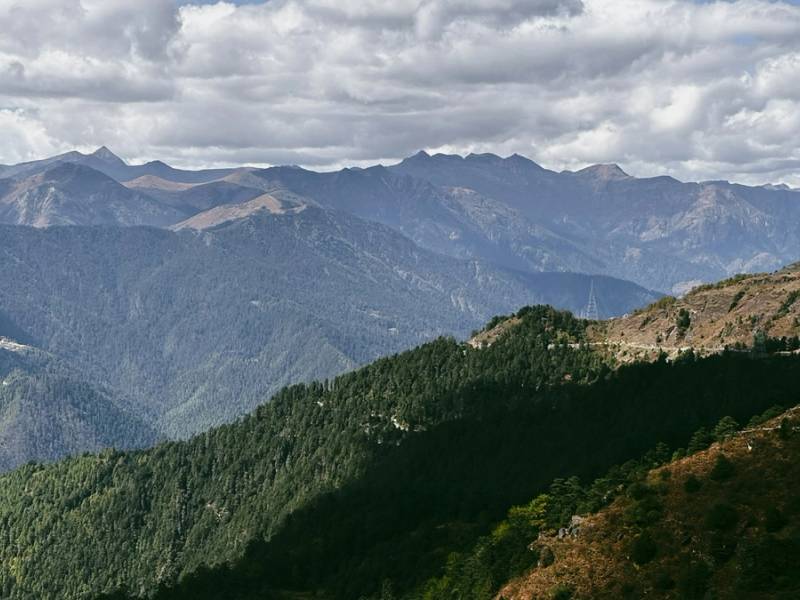
- The view. From the terrace you look out over the valley and the city spread along the Wang Chhu below. Ask your guide to point out the landmarks.
- The people. This is a working place of worship, not only a viewpoint. Local people come to pray, meditate and make offerings, and your guide may well stop to do the same.
- The forest. Walking paths run through the pine forest of the nature park around the statue. Even a short walk out along them gets you away from the crowds at the terrace.
Visiting: dress, photographs and time
- Dress. Treat it as you would a temple: cover your shoulders and knees, and take off hats and shoes before you go into the shrine hall. Our cultural etiquette guide explains why.
- Photographs. You can photograph the statue and the terrace freely. Photography is not allowed inside the shrine hall.
- Walk clockwise around the statue and inside the hall, as you would around any chorten or temple.
- How long. Allow about an hour for the statue, the shrine hall and the view. Add an hour or two if you want to walk in the park.
- How hard. Easy. You can drive almost to the statue, so there is little walking unless you choose to.
- Weather. The hill is a few hundred metres above the town and gets the wind. Bring a warm layer outside summer.
Getting there
The road up to Kuensel Phodrang climbs the hillside from the southern part of town. It takes about 15–20 minutes by car from the centre, depending on traffic.
You can also walk. A forest path of about 1.5–2 km each way links Buddha Point with the hillside above Changangkha Lhakhang, one of the oldest temples in Thimphu. The path is mostly gentle, with some short climbs, and it runs through pine forest with views over the valley. Allow about 2–2.5 hours for the walk there and back, or walk one way and have the car meet you at the other end.
If you are driving in from Paro, look up at the hills as you reach Thimphu. The statue overlooks the southern approach to the city, so it is one of the first things you see of the capital.
Tips from our guides
- Go early or late. The terrace is quietest in the early morning and late afternoon, and the light on the gold is softer.
- Combine it with the Memorial Chorten. Seeing the giant new Buddha and the 1974 Memorial Chorten, where Thimphu’s older residents walk their daily circuits, on the same morning shows two sides of faith in the city.
- Don’t expect an ancient site. The statue is new, and it is as much a symbol of modern Bhutan as a place of worship. That is part of the interest.
- Pair it with Tashichho Dzong at the other end of the valley for a first day in town. Our article on a first day in Thimphu suggests an order, and Tashichho Dzong has its own page.
- Heading east next? The road to Punakha over Dochu La leaves from the southern end of the valley, so a morning visit here fits neatly before the drive.
Last reviewed 24 September 2026
More to see in Thimphu
Tashichho Dzong
The great whitewashed dzong at the northern end of Thimphu holds the throne room, the King's offices and several ministries, and in summer the Central Monastic Body. First built as a dzong by Zhabdrung Ngawang Namgyal in 1641, it was rebuilt by the Third King in the 1960s.
National Memorial Chorten
A white chorten with a golden spire in the middle of town, built in 1974 in memory of the Third King, Jigme Dorji Wangchuck. All day, older residents walk clockwise around it and turn its big prayer wheels. It is the easiest place in Thimphu to watch everyday faith.
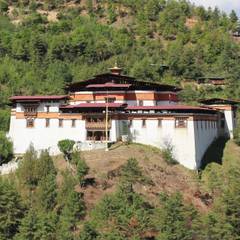
Simtokha Dzong
Built in 1629 by Zhabdrung Ngawang Namgyal, Simtokha was the first dzong he built and is one of the oldest in Bhutan still standing whole. It sits on a ridge about 5 km south of the city centre and is known for the carved slate panels of saints and masters on its outer walls.
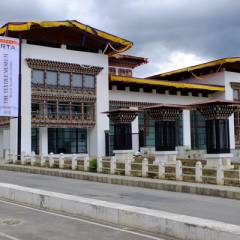
Textile Museum, Royal Textile Academy
The Royal Textile Academy of Bhutan in Chubachu runs the country's main textile museum, under the patronage of the Queen Mother, Gyalyum Sangay Choden Wangchuck. One gallery shows the weaves of each region and another holds changing exhibitions, and there is a weaving centre where you can watch the work.
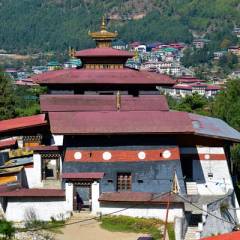
Changangkha Lhakhang
One of the oldest temples in Thimphu, on a ridge above the town, linked to Phajo Drugom Zhigpo and his family, who brought the Drukpa Kagyu school to western Bhutan in the 13th century. Its main image is Chenrezig, the deity of compassion, and parents bring newborn babies here for blessings and names.
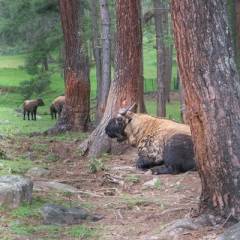
Motithang Takin Preserve
A fenced area of forest in Motithang where you can see the takin, Bhutan's national animal, up close. It began as a small zoo; when the Fourth King had the animals released, the takins wandered the streets of Thimphu, so they were given this preserve instead.
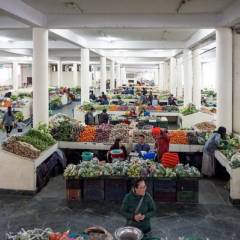
Kaja Throm (Centenary Farmers' Market)
Thimphu's main food market by the Wang Chhu, opened in 2008 as the Centenary Farmers' Market and long known as the weekend market. After a renovation it was renamed Kaja Throm in 2024. Farmers and traders sell vegetables, fruit, grains and dairy produce from across the country.
Planning a trip that includes Buddha Dordenma?
Tell us when you would like to travel. We reply within 24 hours with a free day-by-day plan and a price.

Karma ChodenOperations manager, Bhutan Tour Itinerary
Or call +975 17 81 70 52info@bhutantouritinerary.com
Mon–Sat, 9am–6pm Bhutan time (GMT+6)