Punakha Dzong
- Time needed
- 1.5–2 hours
- Altitude
- 1,200 m
- Best time
- Spring for the jacarandas; February–March for the Drubchen and Tshechu
Highlights
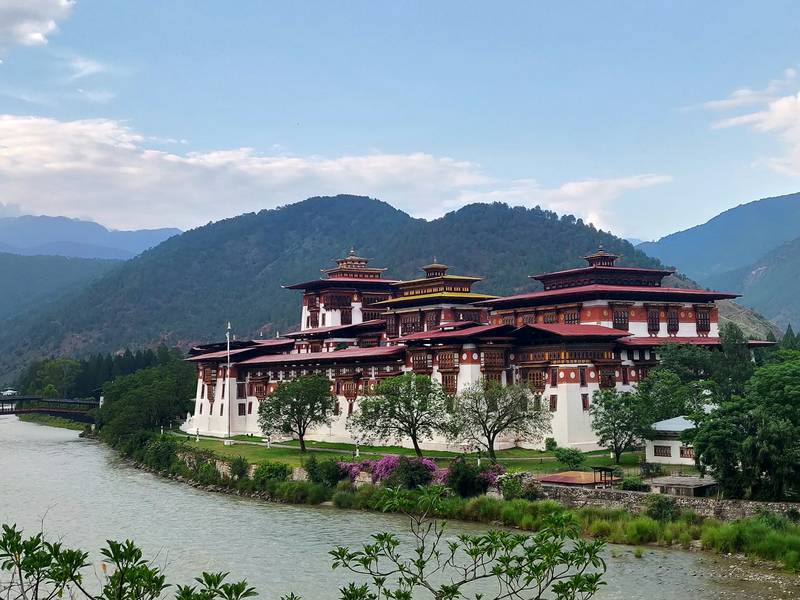
- Where the Pho Chhu and Mo Chhu meet
- First king crowned here in 1907
- Jacarandas flower mauve along the walls in spring
Where two rivers meet
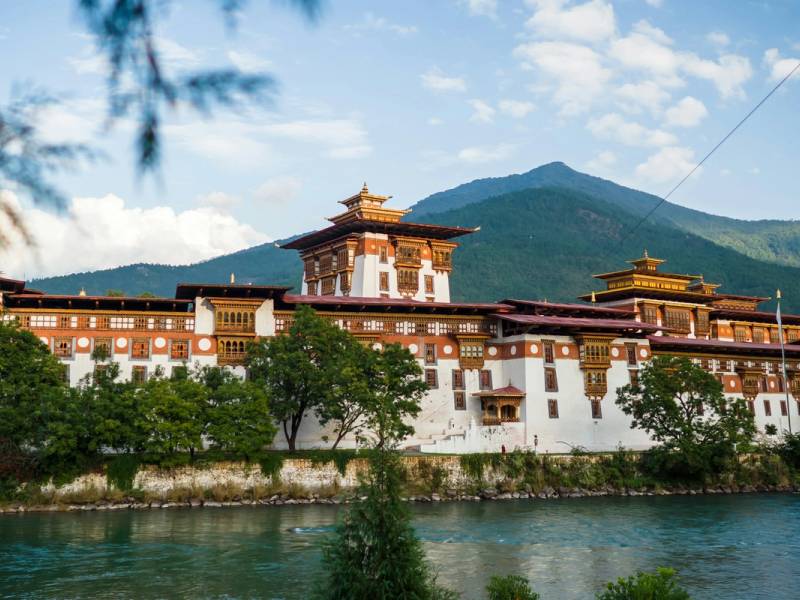
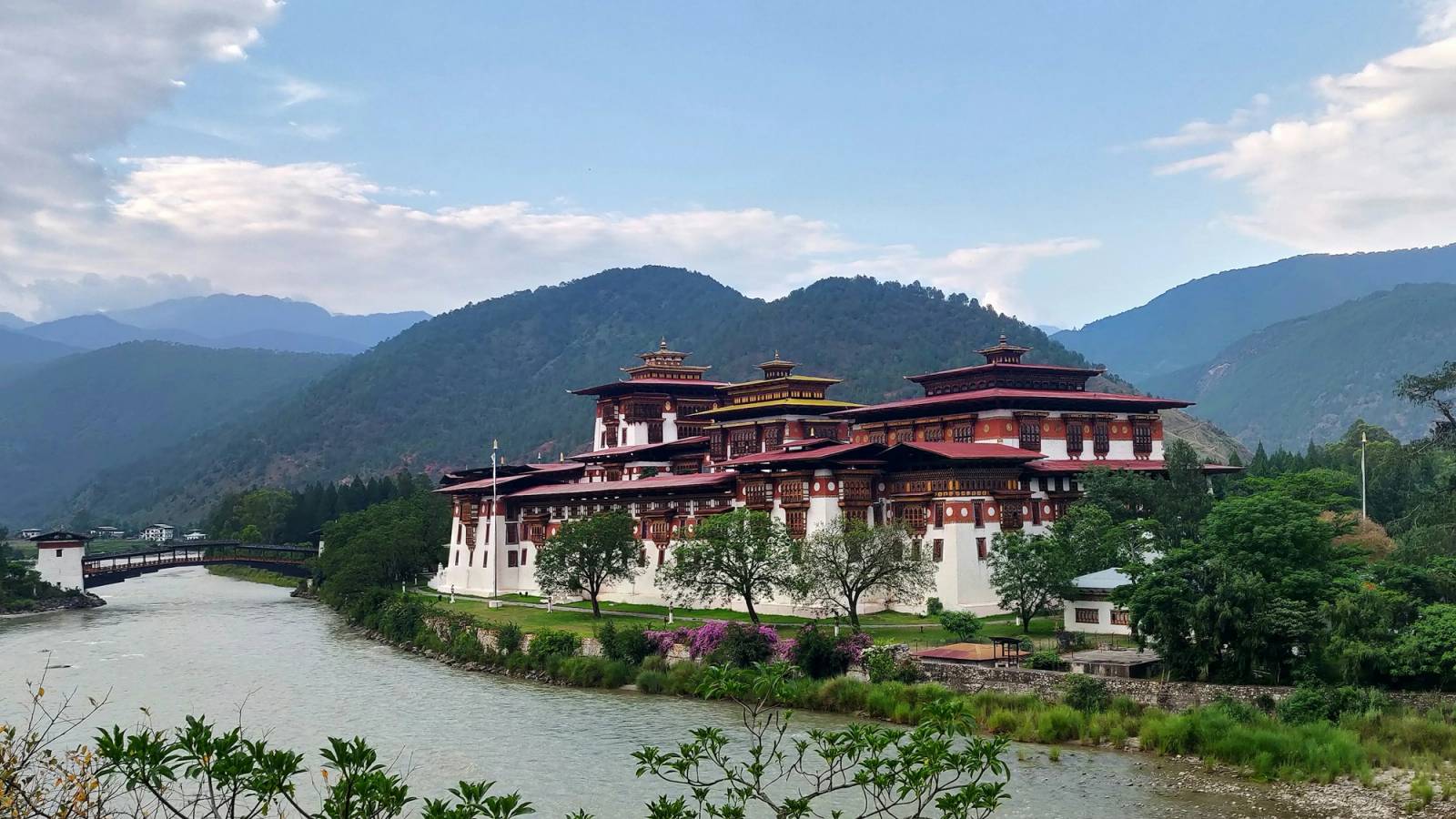
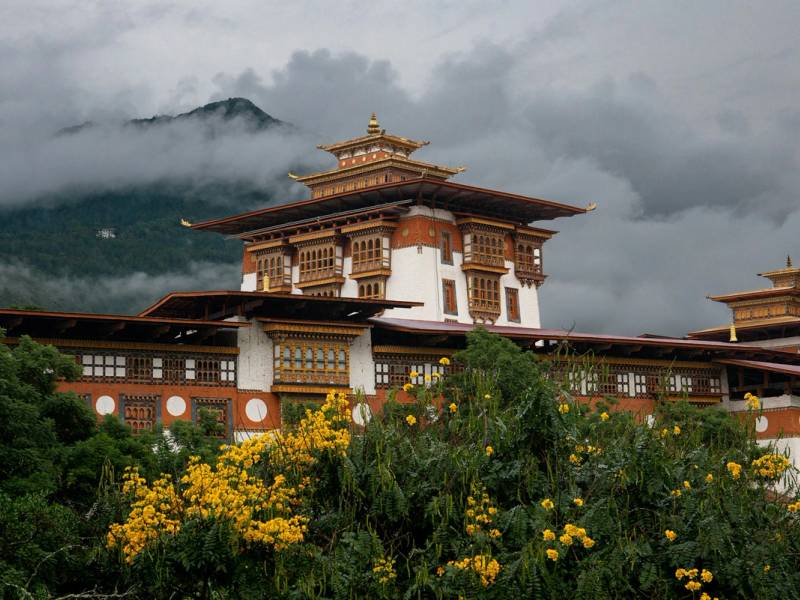
Punakha Dzong sits on a narrow tongue of land where two rivers join. The Pho Chhu, the “father” river, comes down from the glaciers of Lunana. The Mo Chhu, the “mother” river, flows in from Laya and the hills along the Tibetan border. Below the dzong they become one river, the Puna Tsang Chhu, and carry on south. The dzong’s full name is Pungthang Dechen Phodrang, usually translated as the palace of great bliss.
Zhabdrung Ngawang Namgyal, the lama who unified Bhutan in the 17th century, had it built in 1637–38. That makes it the second oldest and the second largest dzong in the country. The story our guides tell starts with a prophecy of Guru Rinpoche: a man named Namgyal would come to a hill shaped like a sleeping elephant, and build on it. The dzong stands at the tip of the elephant’s trunk. Its architect, Zowe Palep, is said to have planned it from a vision he had in a dream, without putting anything on paper.
Capital, coronation hall and winter home of the monks
For more than three hundred years this was where Bhutan was governed. The first king, Ugyen Wangchuck, was crowned here in 1907, and Punakha stayed the capital until the government moved to Thimphu in 1955. In 2011 the present king, Jigme Khesar Namgyel Wangchuck, married Queen Jetsun Pema in the dzong.
It is still a working building. The district administration has its offices here, and the Je Khenpo, Bhutan’s chief abbot, spends the winter here with the central monk body, when the valley is far warmer than Thimphu. In summer they move back up to Tashichho Dzong.
The dzong has had a hard life. Fires damaged it many times between the mid-18th and mid-19th centuries, an earthquake hit it in 1897, and a fire in 1986 destroyed part of it. Floods from glacial lakes far upstream reached it in 1957, 1960 and 1994. What you see today is the work of a long restoration by Bhutanese craftsmen, marked by a consecration ceremony in 2004.
The bridge and the steep way in
You arrive over a covered wooden cantilever bridge across the Mo Chhu. The first bridge here was built with the dzong and was washed away by a flood in the late 1950s. The one you walk on was built in the traditional way, with a free span of 55 m, and finished in 2008.
There is only one entrance, up a flight of very steep wooden steps. They were made so they could be pulled up if the dzong was attacked, and the heavy door at the top is still shut at night.
Three courtyards instead of two
Most dzongs have two courtyards. Punakha has three, and each has its own job.
- The first courtyard is the administrative one, with district offices around it, a large white chorten and a bodhi tree.
- The second courtyard belongs to the monks, with their quarters on the galleries around it.
- The third courtyard holds the Machey Lhakhang, where the remains of the Zhabdrung are kept. It is not open to visitors.
The Zhabdrung died here in 1651. His ministers kept the death secret for more than fifty years, saying he was on a long retreat and issuing orders in his name, so the young state would not fall apart. The dzong also keeps the remains of the treasure-revealer Pema Lingpa and the Rangjung Kharsapani, a self-arisen image of Chenrezig (Avalokiteshvara) that the Zhabdrung brought with him from Tibet. That relic was one of the reasons Tibetan armies invaded Bhutan several times in the 17th century.
What to look for
- The Kuenrey, the great assembly hall, which visitors can usually enter. The walls carry murals of the life of the Buddha, and large gilded statues of the Buddha, Guru Rinpoche and the Zhabdrung sit at the front.
- The central tower, or utse, which rises six storeys between the courtyards.
- The woodwork: carved and painted window frames, brackets and galleries. Look up as much as around.
- The jacaranda trees along the walls, which flower mauve in spring.
The festival that re-enacts a battle
Every year in February or March, the Punakha Drubchen (also called the Dromche) re-enacts the 17th-century fighting in which the Zhabdrung’s forces drove off a Tibetan army. Local men dressed as pazaps, the old militia, in red and black with swords, stage the battle in and around the dzong and on the bank of the Mo Chhu. The Punakha Tshechu, with masked dances in the courtyards, was added in 2005 and follows straight after it.
The dates follow the lunar calendar and change every year. Check our festival calendar, read what to expect at a tshechu, or look at the Punakha Drubchen and Tshechu tour.
Visiting: dress, photos and time
- Dress: long sleeves and long trousers or a long skirt, with no hats inside. Bhutanese wear a ceremonial scarf, the kabney or rachu, to enter a dzong. Our cultural etiquette guide explains the rest.
- Photos: fine in the courtyards and from outside, not inside the temples and shrine rooms.
- Time: about 1.5 to 2 hours to walk through without hurrying, longer if you add the suspension bridge.
- Monks and officials work here, and some halls close for rituals or official business. Your guide will check on the day what can be seen.
Getting there
Punakha is about 2.5 to 3 hours by road from Thimphu, over Dochu La. The dzong is a short drive from Khuruthang, the district town, and you cross the Mo Chhu on foot by the cantilever bridge. The Punakha page covers the rest of the valley, and getting around Bhutan explains how road travel with a guide and driver works.
Tips from our guides
- Come in the morning or late afternoon. Punakha is warm in winter and hot in summer, and the open courtyards get hot in the middle of the day.
- Winter is a good time to visit. The valley stays mild when Thimphu is cold, and the monk body is in residence. See best time to visit.
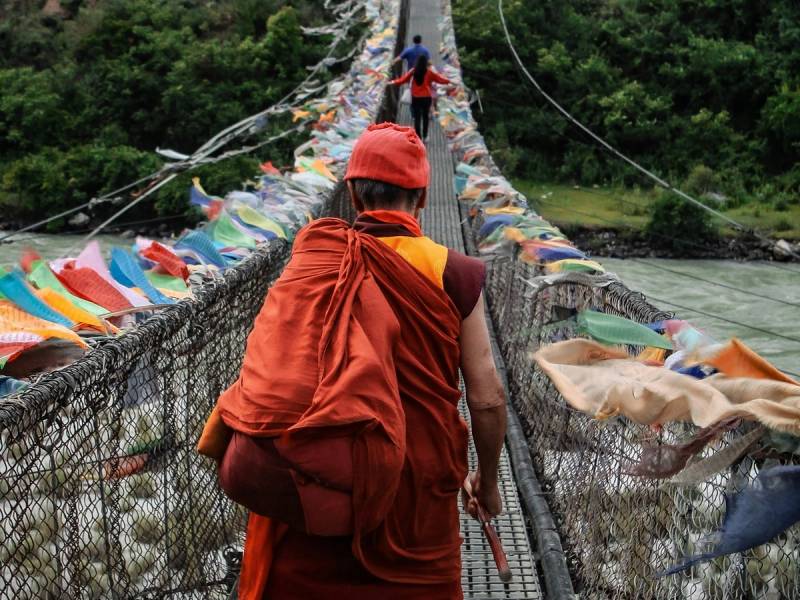
- Walk up the Pho Chhu afterwards to the suspension bridge, one of the longest in Bhutan.
- Combine the dzong with Chimi Lhakhang on the same day. It sits on the road in from Thimphu.
- The Punakha district administration keeps a short page on the dzong (opens in a new tab) with its history and the story of the two rivers.
Last reviewed 24 September 2026
More to see in Punakha
Chimi Lhakhang
A small temple on a hillock among the rice fields near Lobesa, built in 1499 on a site blessed by Drukpa Kunley, the Divine Madman. Couples hoping for a child come here for a blessing, and the walk in from Sopsokha takes about 20 minutes.
Dochu La
The pass at about 3,100 m on the road from Thimphu to Punakha, where 108 chortens honour the Bhutanese soldiers who died in 2003. On a clear winter morning the high Himalaya is on show, and most people stop here on the drive.
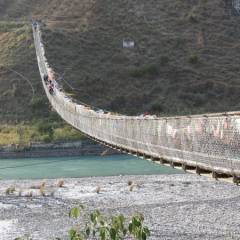
Punakha suspension bridge
A long footbridge of steel cables and wooden planks across the Pho Chhu, a short walk from Punakha Dzong and one of the longest suspension bridges in Bhutan. It sways as you cross, it is hung with prayer flags, and it leads to the villages on the far bank.
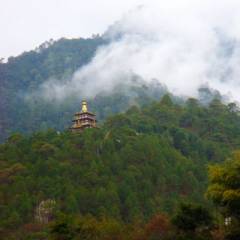
Khamsum Yulley Namgyal Chorten
A tiered chorten on a ridge above the Mo Chhu, built under Queen Mother Ashi Tshering Yangdon Wangchuck to ward off harmful forces and bring peace. It is about 30 minutes uphill from the footbridge at Yepaisa, through rice fields and pine, with wide views of the valley from the top.
Planning a trip that includes Punakha Dzong?
Tell us when you would like to travel. We reply within 24 hours with a free day-by-day plan and a price.

Karma ChodenOperations manager, Bhutan Tour Itinerary
Or call +975 17 81 70 52info@bhutantouritinerary.com
Mon–Sat, 9am–6pm Bhutan time (GMT+6)