Hotels in Bhutan
Tourists stay in government-certified hotels. Our prices include a certified 3-star room; 4- and 5-star are upgrades we price per night.
On this page
Tourists stay in government-certified hotels. Our prices include a certified 3-star room; 4- and 5-star are upgrades we price per night. The USD 100 Sustainable Development Fee is separate and the same whichever hotel you choose.
Which hotels can tourists stay in?
Only properties approved by the Department of Tourism (opens in a new tab), which lists them on its services portal. Hotels are rated one to five stars. Since April 2023 one- and two-star hotels (certified as Blue Poppy 1 and 2) can host tourists too, so small towns such as Trashigang now have legal options.
Certified stock, checked September 2026: 20 five-star, 23 four-star, 202 three-star, 60 two-star and 92 one-star.
You can book a hotel yourself; a tour operator is no longer required. What we add is contracted rates and someone in Thimphu to call when the hot water fails at 9 pm.
Why is 3-star our standard?
With 202 certified properties it is where the real choice sits; below it, options thin fast outside Thimphu and Paro. National occupancy runs around 50–55%, so outside festival weeks a quiet week in Punakha often buys a better room than the rate suggests.
What does a 3-star room give you?
A good 3-star room in Paro or Thimphu has:
- En-suite bathroom with an electric geyser for hot water
- Twin or double beds, wooden floors, painted timber window frames
- Kettle, tea, daily housekeeping
- A restaurant with set buffets, ema datshi and red rice alongside a milder dish
- Wifi in the lobby, usually in the room
What it usually lacks: a lift in older buildings, air conditioning, a minibar, dependable room service, and steady water pressure when the hotel is full.
What do 4- and 5-star add?
| Property | Where | What the money buys |
|---|---|---|
| Zhiwa Ling Heritage | Paro | Bhutanese stone and timber build, in-house temple |
| Taj Tashi | Thimphu | Full-service city hotel, dzong-inspired interiors |
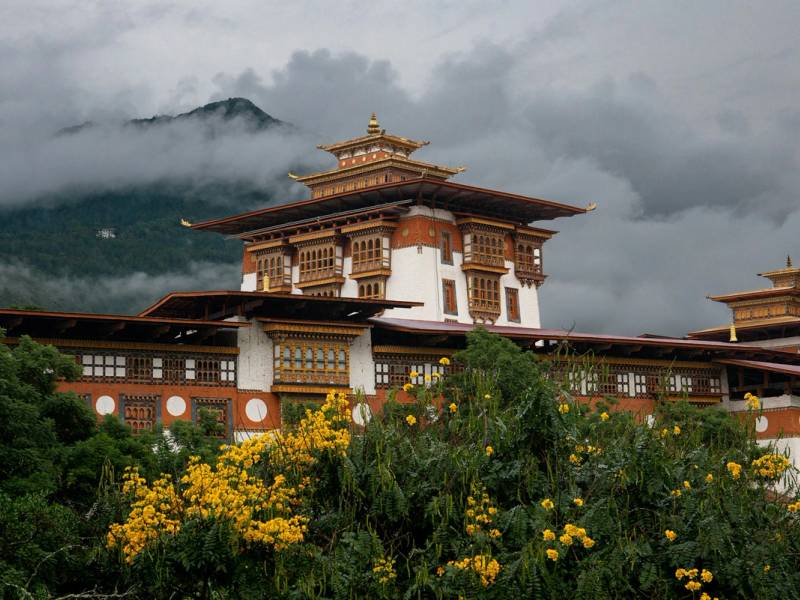
| COMO Uma | Paro and Punakha | Valley-facing rooms, spa, guided walks |
| Pemako Punakha | Punakha | Riverside villas, private pools |
| &Beyond Punakha River Lodge | Punakha | Tented suites on the Mo Chhu |
| Gangtey Lodge | Phobjikha | Farmhouse conversion above the crane valley |
| Six Senses | Five lodges | Multi-lodge circuit, full board, spa at each |
| Amankora | Five lodges | Multi-lodge circuit, bukhari-warmed suites, hot-stone baths |
Warmth, water and service: heating that holds all night, 24-hour hot water, a spa, a hot-stone bath you book rather than improvise. Six Senses and Amankora are circuits: you move between their lodges.
Room-only rates before the SDF start around USD 350 a night at the heritage end and run past USD 1,500 at Amankora and Six Senses. Treat those as indicative; we quote live rates. Our luxury tours are built around these properties.
Will the room be warm in winter?
Central heating is rare. Below the top tier you get a bukhari, a wood stove staff light on request, often backed by an electric heater. Hot water comes from an electric geyser, so it can run out when the hotel is full. Bumthang, Phobjikha, Haa and Gasa are where this bites hardest.
We raise it at the quote stage and move winter guests to hotels with in-room heaters where the valley allows. See best time to visit, weather by region and what to pack.
Is there wifi?
Most certified hotels have it: fine in Thimphu, patchy in valley lodges, thin east of Trongsa. For reliable data buy a local SIM at Paro airport; see SIM cards and internet.
Where are the best hotels, region by region?
- Paro and Thimphu: the deepest choice, every tier.
- Punakha: the strongest luxury cluster for its size, in a valley far warmer than Thimphu.
- Phobjikha and Gangtey: lodge-style, cold, limited. Book early for crane season.
- Bumthang: solid 3-star, very few 4-star.
- Trongsa, Mongar, Trashigang, Lhuentse: certified but simple, with bukhari heat, short menus and slow wifi.
East of Trongsa, homestays and farmhouses are often the better room, not the compromise. On treks you sleep in tents.
What about festival dates and travelling alone?
Rooms in Paro and Thimphu sell out during their tshechus while the rest of the country has space. Enquire at least three months ahead for festival dates, and earlier to sleep in Paro town during Paro Tshechu. Dates are in our festival calendar.
Travelling alone, you pay a single supplement for a double room. It is the hotel’s charge, not a government one, and the SDF is unaffected. We confirm it per hotel when we quote.
What we do for you
Give us a nightly budget and we build the hotel list around it: 3-star throughout, one or two nights lifted, or the lodge circuits end to end. We handle the visa, the SDF, flights, hotels, your guide and vehicle. Send us your dates and we send a free day-by-day plan and price, with named hotels, within 24 hours.