Responsible travel in Bhutan
Bhutan absorbs about 6.5 times the carbon it emits — here is how to travel it without adding to the load.
On this page
- Carbon negative, and the number that matters more
- What responsible sustainable travel in Bhutan costs — and funds
- Water, plastic and power
- On trek: pack it in, pack it out
- Cranes, takin and snow leopard country
- Money that stays in the village
- Permission: shrines, monks and cameras
- Where tourism still costs Bhutan
- Plan it with us
Bhutan absorbed roughly six and a half times more carbon than it emitted in 2022, so responsible sustainable travel in Bhutan is less about offsetting your visit than about not adding to a load the country already carries. This guide also names where tourism still costs us something.
Carbon negative, and the number that matters more
The 2025 National Biodiversity Strategy and Action Plan puts Bhutan’s 2022 emissions at about 1.74 million tonnes CO2e against roughly 11.45 million tonnes sequestered by forests, croplands and grasslands.
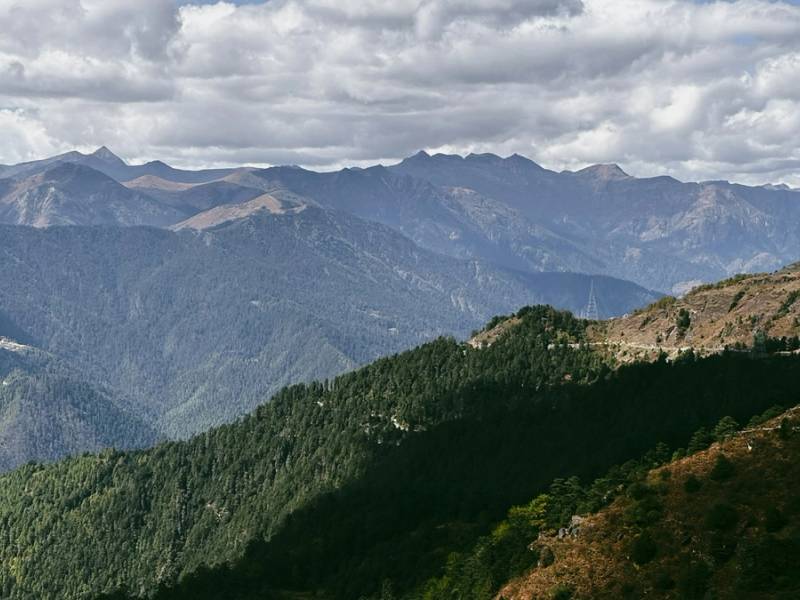
That surplus rests on trees, and the trees rest on law. Article 5 of the 2008 Constitution requires at least 60% of the country to stay under forest cover “for all time to come” — a floor in the founding document, not a target in a five-year plan. The Ministry of Foreign Affairs (opens in a new tab) publishes the official summary.
Actual cover is 69.71%, about 2.68 million hectares, from National Forest Inventory fieldwork in 2021–22 — down from around 71% in 2016. It clears the floor comfortably, but the direction is what to watch, and the reason we quote the real figure rather than the rounder, older one.
What responsible sustainable travel in Bhutan costs — and funds
High Value, Low Volume dates to the early 1970s under the Fourth Druk Gyalpo, Jigme Singye Wangchuck, and was restated in 2008 as High Value, Low Impact. There is no numeric cap on visitor numbers — the Sustainable Development Fee is the only lever.
The legal SDF rate is USD 200 per person per night. A 50% incentive discount has applied since 1 September 2023 and is stated to run until 31 August 2027.
| Visitor | SDF per person per night |
|---|---|
| Adult, most nationalities | USD 100 (discounted from USD 200) |
| Indian nationals | INR/Nu 1,200 |
| Children 6–11 | 50% of the applicable rate |
| Children 5 and under | Exempt |
It is waived for 24-hour visits to the border towns of Samtse, Phuentsholing, Gelephu and Samdrup Jongkhar. Check current notices on the Department of Tourism site (opens in a new tab).
That revenue goes into the consolidated state budget under Article 14 and funds free healthcare and free education for citizens, conservation, cultural preservation and infrastructure. It is a citizen-services contribution, not a park ticket — nobody hands you a wristband. In 2025 Bhutan collected over USD 43 million from 209,376 visitors.
More in our SDF guide, travel budget and how to book.
Water, plastic and power
Bhutan’s plastic ban is narrower than its reputation. The 1999 notification covered three items: plastic carry bags, doma (betel nut) wrappers and ice-cream pouches. It was reinforced from 1 April 2019 with fines of Nu 500 for a first offence, though officials admit inspections stay rare in many places.
PET bottles are not covered, nor are packaged goods, and those are now the bulk of the plastic in the waste stream. Bhutan generates around 172 metric tonnes of waste a day, about 50 MT of it in Thimphu, plastics making up roughly 36%.
Carry a filter bottle. Two weeks at three bottles a day is 42 PET bottles you did not add, and our vehicles and hotels refill you all day. Our packing guide covers the rest.
Electricity is seasonal too. Hydropower is over 99% of generation and Bhutan exports surplus to India roughly May to November, but in the dry winter lean season it turns net importer — India approved 1,250 MW for 2025. Switching off the heater in Bumthang in January is not a token gesture.
On trek: pack it in, pack it out
In August and September 2026 a CleanWave team walked 19 days from Gasa to Bumthang on the Snowman route and collected 189 sacks of waste, mostly beverage bottles, hauled out by about 30 horses. They still found streams they could not clear. Nor is this only a tourist problem: Bhutan Swallowtail has cleaned the Druk Path since 2017, single clean-ups topping 60 sacks.
Our trek rules, briefed before day one:
- Nothing burned, nothing buried. It leaves on a horse or in a pack.
- Organic waste comes out too above the treeline, where almost nothing breaks down.
- Toilet stops well away from water, and no soap in streams.
- Stay on the trail through alpine meadow — braided paths take years to heal.
See our trekking guide and trekking tours.
Cranes, takin and snow leopard country
The 2024–25 winter count recorded 709 black-necked cranes, nearly double the first survey in 1987. Phobjikha held about 640–650 of them, including roughly 75 juveniles; the other wintering grounds are Bumthang and Bumdeling.
Higher up, the National Snow Leopard Survey of 2022–23 confirmed 134 snow leopards, up 39.5% on the 96 counted in 2016. Bhutan counted 131 tigers in 2021–22, and camera traps in Wangchuck Centennial National Park have photographed both species at the same spots — very few places on earth can say that.
The takin, Bhutan’s national animal, carries a Drukpa Kunley legend; a small herd lives at the Motithang Takin Preserve above Thimphu, and we confirm current opening details when we plan that day.
Watching rules: keep your distance, never play recorded calls, no drones near roosting cranes, no feeding. For seasons and parks, see best time to visit and the Department of Forests and Park Services (opens in a new tab).
Money that stays in the village
Village homestays are regulated. The Village Homestay Guidelines 2026 took effect in January 2026 and require certification and registration with the Department of Tourism. They state plainly that a homestay complements a farming household’s livelihood rather than replacing it: the money reaches the family and the fields stay worked. See homestays and farmhouses and our cultural tours.
Most handicraft shops here stock imports from Nepal and north-east India. A Collective Mark certification launched in 2024 to separate Bhutanese work from imports, and it is still being rolled out. Until it is everywhere, buy at the workshop and ask who made the piece. Learn the Zorig Chusum categories too — the thirteen traditional arts, taught in Thimphu, that even graduates struggle to live on.
Tipping is not obligatory and there is no service charge convention. Guides and drivers on multi-day trips are customarily tipped at the end, directly and separately. Amounts vary, so we send our current guidance with your final documents rather than publish a number that goes stale. See money and payments.
Permission: shrines, monks and cameras
Exteriors, dzong courtyards and festival dance grounds are generally fine. The interiors of chapels, lhakhangs and goemba shrine rooms are almost always off-limits, and flash is usually banned even where cameras are allowed. A breach can get you removed and can put your guide’s licence at risk, which is why you ask the guide, not the sign.
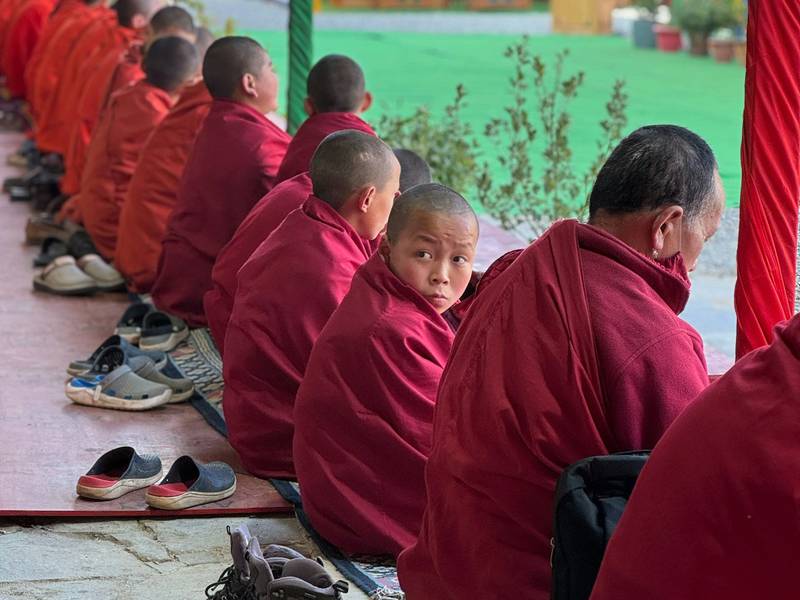
With people, ask before photographing monks, elderly villagers and children, and accept a no. There is no fee and no permit — consent, not payment. Our cultural etiquette guide and festival calendar have the detail; our festival tours build the dance grounds into the itinerary.
Where tourism still costs Bhutan
- Arrivals rose 44.33% in one year. A price lever is not a cap, and busy months feel busy.
- The ban covers three 1999-era items and is barely enforced. PET is legal and everywhere.
- Trail waste is cleaned by volunteers and operators, not by a system.
- Craft authenticity stays unresolved while the Collective Mark rolls out.
- High Value, Low Volume is fairly criticised for keeping Bhutan mainly within reach of the wealthy.
Flights are the other honest cost. Paro is the only international airport and only Drukair and Bhutan Airlines fly in; Bhutan Airlines offers a voluntary CarbonClick offset (opens in a new tab) at booking. Take it, but an offset does not cancel a flight — one longer trip beats three short ones. See getting to Bhutan.
Plan it with us
Check yourself against five things: refill instead of buying bottled, carry out everything you carry in, ask before you photograph a person or a room, buy from the workshop rather than the airport shelf, and come for longer rather than more often.
Tell us your dates and what you want to see and we will build the trip around it, villages included. Start with our tours or send an enquiry.