Gangtey Monastery
- Time needed
- About 1 hour; half a day with the nature trail
- Altitude
- 3,000 m
- Best time
- Any time of year; 11 November for the Crane Festival
Highlights
- Seat of the Pema Lingpa tradition, founded 1613
- Black-necked Crane Festival every 11 November
- More than 100 pillars carved by hand
A prophecy and a grandson
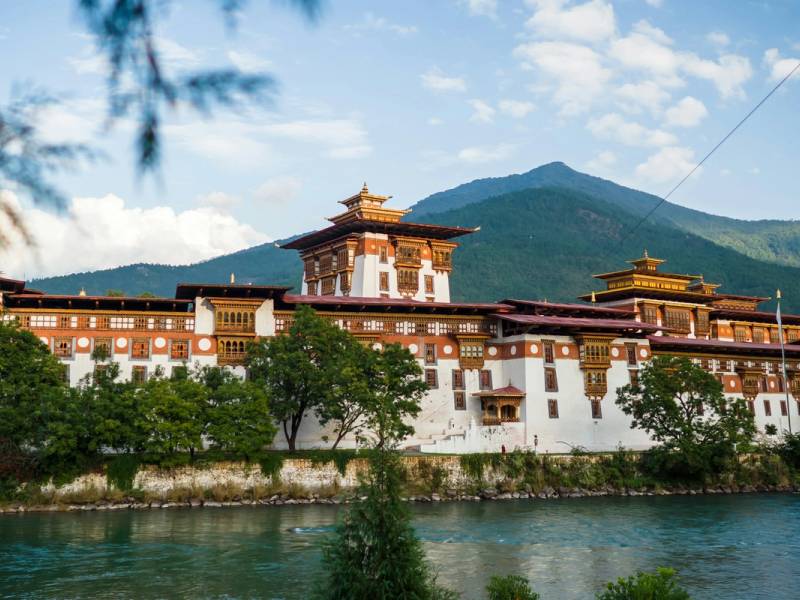
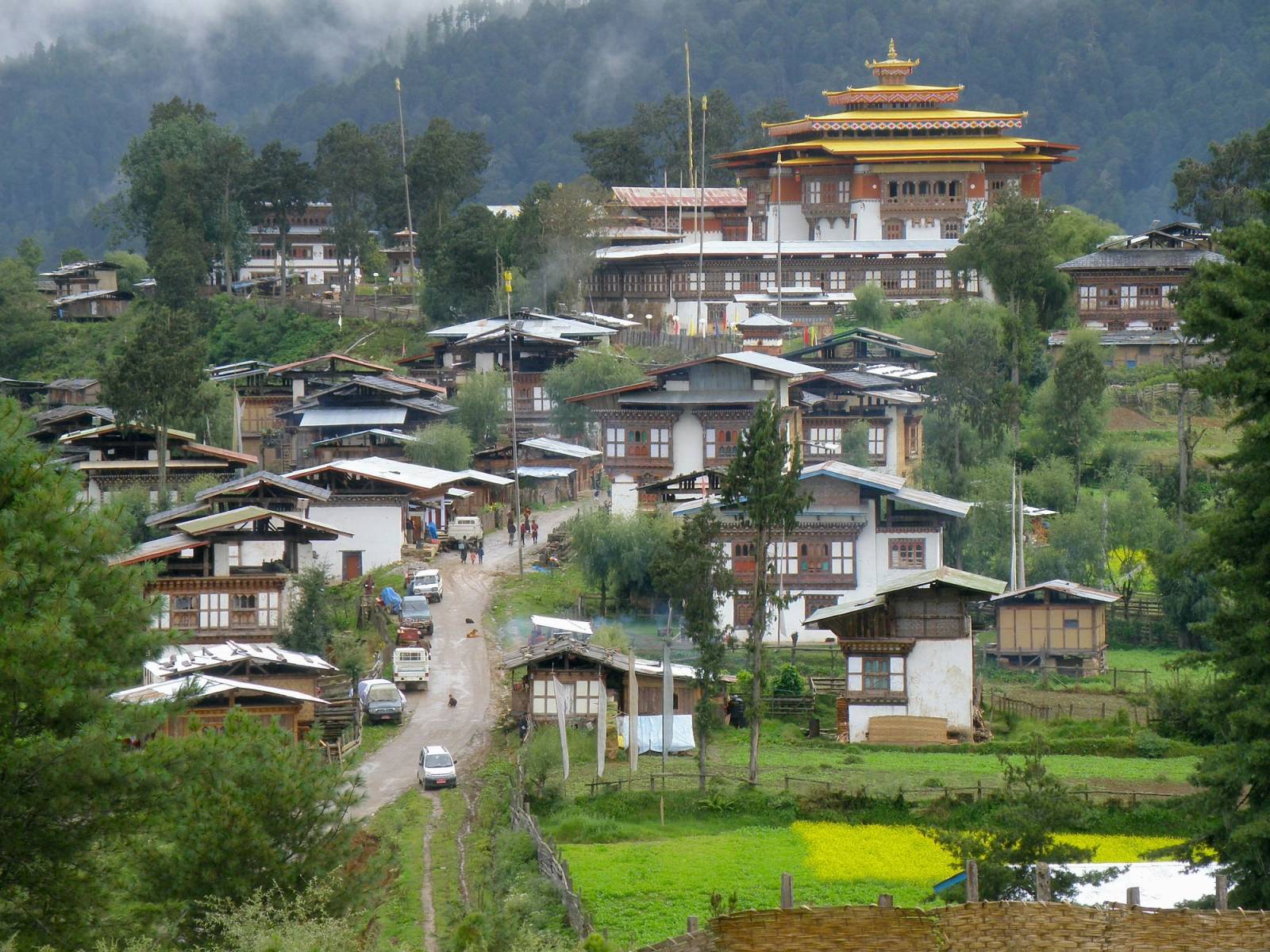
Gangtey Goenpa, properly Gangteng Sang-ngak Chöling, sits on a forested spur above the Phobjikha valley, with Gangteng village gathered around its walls. It is a monastery of the Nyingma school and the main seat of the Pema Lingpa tradition, known as the Peling tradition, one of the two main centres of the Nyingma school in Bhutan.
Its story starts with the treasure revealer Pema Lingpa (1450–1521). On a visit to Phobjikha he looked at the mountains around the valley and foretold that one of his descendants would build a monastery on the gang teng, the “top of the mountain”, and make it the seat of his teachings. His grandson, Gyalse Pema Thinley (1564–1642), laid the foundation in 1613 and became the first Gangteng Trulku, the line of reincarnate lamas who still head the monastery.
It began as a small village temple. Pema Thinley’s son, Tenzin Legpai Dhendup (1645–1726), the second trulku, expanded it and gave it the look of a dzong. The link to Pema Lingpa runs beyond the monastery too: the Wangchuck kings, who rose to power in Trongsa, trace their descent to the same saint.
The rebuild of 2002 to 2008
By the end of the 20th century much of the old woodwork had decayed. Under the ninth Gangteng Trulku, Rigdzin Kunzang Pema Namgyal, the monastery was restored between 2002 and 2008. Decayed timber was replaced and the original structure kept where it could be. The first builders had used timber and stone from the hills around the valley; this time local carpenters carved more than a hundred new pillars, and long beams of blue pine, by hand. The restored monastery was consecrated on 10 October 2008 in the presence of the Fourth King.
What to look for
- The central tower and courtyard. The tall central tower, the utse, stands in the courtyard with five temples around it. The courtyard is where the festivals happen, and from it you look out over the valley.
- The main assembly hall. The tshokhang is built around eight very large wooden pillars. Stand back and look up at the carving on the beams and brackets.
- The plan. The builders gave the monastery a square plan, which stands for perfection in teaching and practice, and 108 doors and windows.
- The people. The monastery is kept by a community of about a hundred gomchen, lay monks, and a monastic college, Do-ngag Tösam Rabgayling, stands above the village.
The cranes and the goenpa
People in Phobjikha say the black-necked cranes circle the goenpa three times when they arrive from Tibet in late October, and again before they leave. You may or may not see it, but you will hear it told.
Every year on 11 November the monastery courtyard hosts the Black-necked Crane Festival, started in 1998 and held here since 2005 with the blessing of the Gangteng Trulku. Schoolchildren perform a crane dance in costume, and local people and monks perform folk songs and mask dances. RSPN’s history of the festival (opens in a new tab) has the background. The goenpa also holds its own tshechu; check the festival calendar for the year’s dates, and read a first-timer’s guide to tshechu festivals if it is your first.
Visiting: dress, photos and time
This is a working monastery, not a museum, so dress and behave as you would in any temple in Bhutan:
- Cover your shoulders and knees. Long sleeves and long trousers or a long skirt are right; take off hats and sunglasses before you go in.
- Take your shoes off before entering the temples, and walk around the courtyard and shrines clockwise.
- Photographs are fine in the courtyard and outside, but not inside the temples. Ask before photographing monks.
- Keep your voice low, and do not touch statues, offerings or ritual objects.
Our cultural etiquette guide explains the reasons behind each of these.
Allow about an hour for the goenpa itself. It is not a hike: the road comes most of the way up the spur, and inside there are only steps and high door sills to deal with. At about 3,000 m, take the stairs slowly if you have just arrived from lower valleys.
Getting there
Gangtey Goenpa is in the Phobjikha valley, about 3 hours by road from Punakha and about 5 to 6 hours from Thimphu. The road leaves the main east–west highway before Pele La and crosses Lawa La into the valley. Once you are in Phobjikha, the goenpa is a short drive up from the valley floor. The Wangdue Phodrang district’s page on the monastery (opens in a new tab) has more on its history and layout.
Tips for a good visit
- Go early or late. The light on the valley is best in the morning and late afternoon, and it is quieter.
- Walk down afterwards. The Gangtey Nature Trail starts just below the goenpa and takes about one and a half to two hours down through Semchubara village and forest to the valley floor. Ask your driver to meet you at the far end.
- Dress for the cold. From November to February, mornings at this height are frosty, and the courtyard stones can be icy.
- Plan early for the festival. Rooms in the valley are limited, and they can fill up around 11 November.
- Combine it with the cranes. In winter, visit the crane centre on the valley floor the same day, and see the goenpa from below as well as the valley from above.
Last reviewed 24 September 2026
More to see in Phobjikha and Gangtey
Black-necked Crane Education Centre
RSPN's centre on the edge of the Phobjikha wetland, once called the Black-necked Crane Visitor Centre. Films and displays explain the cranes and how the valley protects them, and spotting scopes on the observation deck let you watch the birds feed without disturbing them.
Gangtey Nature Trail
A gentle walk of about one and a half to two hours from just below Gangtey Goenpa, down through Semchubara village and conifer forest to the open valley floor near Khewang Lhakhang. In winter it looks out over the cranes' feeding grounds.
Planning a trip that includes Gangtey Monastery?
Tell us when you would like to travel. We reply within 24 hours with a free day-by-day plan and a price.

Karma ChodenOperations manager, Bhutan Tour Itinerary
Or call +975 17 81 70 52info@bhutantouritinerary.com
Mon–Sat, 9am–6pm Bhutan time (GMT+6)